
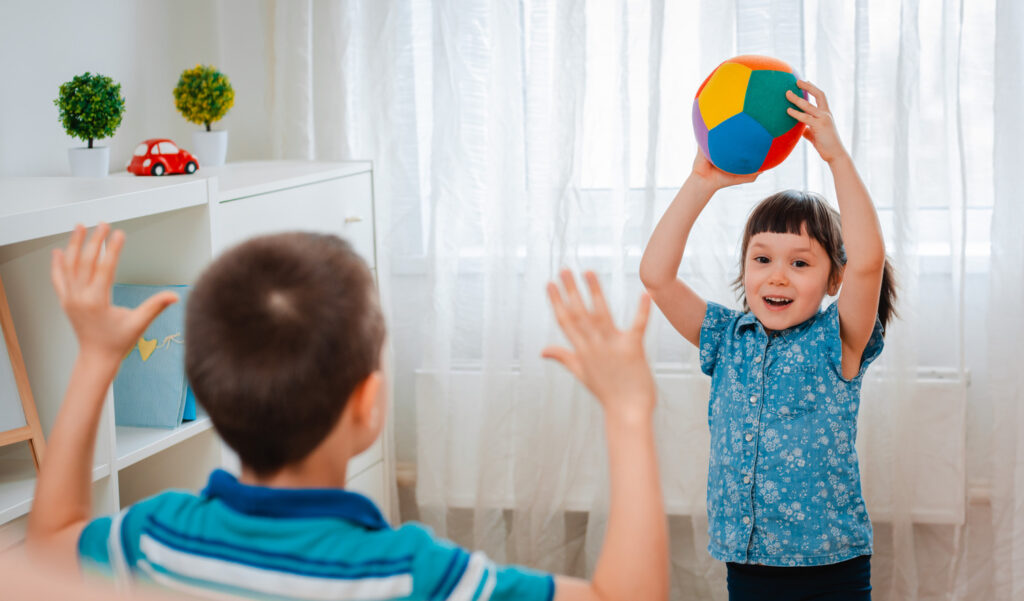
Bilateral coordination is the ability to move both sides of the body at the same time in a controlled manner. This is needed for many activities of daily living, and many play activities! Things like dressing, tying shoes, jumping, riding a bike, climbing stairs, catching, and running all require bilateral coordination.
There are several different types of bilateral coordination, which require your child to move in different ways. Two types of bilateral coordination are symmetrical and reciprocal coordination.
Activities which involve symmetrical bilateral coordination require both sides of the body to move in the same way, at the same time.
Reciprocal coordination activities involve opposite sides of the body moving at the same time, in different directions (think of walking!). Occupational and physical therapists can help to assess what types of coordination that your child is finding most challenging, and provide recommendations to help.
What are some symmetrical bilateral coordination activities?
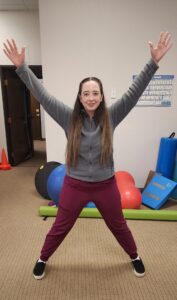
Jumping Jacks

-
- Try by starting slow, and breaking the movement into pieces! Start by having your child to stand like a pencil, with body aligned and arms by their side. Then jump into a “star” pose, with arms and legs out! Repeat, using “star” and “pencil” as verbal cues, until your child is able to speed up the movement!
Catching a Ball
-
- Make sure the ball is large enough to require both hands to catch!
Jumping Rope
-
- This is another activity to break into pieces. Start with just jumping with both feet taking off and landing at the same time. Next, add jumping over a low object. Move on to jumping while mimicking the jump rope movement without using a rope, before slowly beginning to incorporate the rope into the movement!
Pushing or Pulling with Both Hands
-
- Tug of war is great for this!
Scissor Walks or Jumps


- Remember: Same side of the body synchronized for this one.
- Have your child stand with one leg in front of the other, and arms held extended in front and behind the body. The same side arm and leg should be in front. Next, have them walk or jump to switch which arm and leg is in front of them! The arm and leg on the same side of the body should move simultaneously (left arm and left foot).
What are some reciprocal bilateral coordination activities?
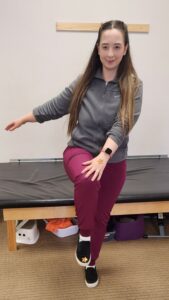
Cross Crawls
-
- Touch hand or elbow to the opposite foot, while counting to 10 or 20 – Then switch sides!
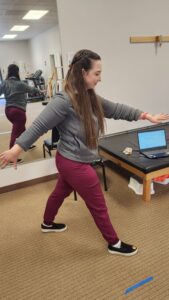
Scissor Walks or Jumps
- Reminder: Opposite sides of the body synchronized for bilateral coordination!
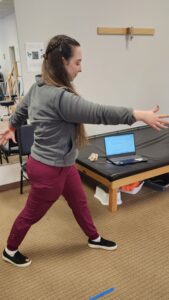
- Have your child stand with one leg in front of the other, and arms held extended in front and behind the body. The opposite side arm and leg should be in front. Next, have your child walk or jump to switch which arm and leg is in front. The opposite arm and leg should move simultaneously (right arm and left foot).
- Try putting stickers on the right hand and left foot, for an additional visual cue!

Scissor Walks – Opposite Sides! Scissor Walks – Time to Switch Sides!
Bicycle Riding
-
- Start on a stationary bike, if you have one available. Or, start by having your child lay on their back and ride an imaginary bicycle!
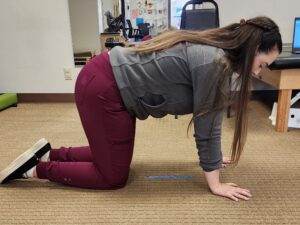
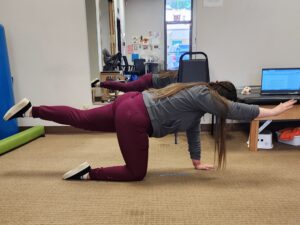
Bird Dogs
-
- Have your child start on hands and knees. Then, extend the opposite arm and leg until they make a straight line with the body. Lower the arm and leg back to the starting position. Repeat on the opposite side.
Tip for Success!
Colored stickers are a great tool to use, while practicing bilateral coordination activities. Consider using them to help your child to have a visual cue for which side of their body they need to use during each activity, ie. stick on hand/foot they need to be using together. Bilateral coordination practice can be challenging, so if your child is having trouble, please reach out to your therapist for tips and modifications.