If you’ve ever watched your child during a therapy session, you may have found yourself wondering, “Are they really doing therapy right now?”
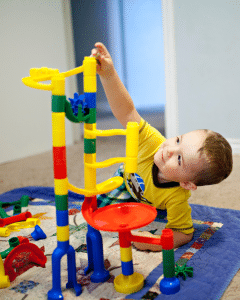
There might be a game happening on the floor, a scooter board moving across the room, a pretend kitchen in use, bubbles floating through the air, or an obstacle course that looks more like recess than therapy. Your child may be laughing, running, building, pretending, or playing with a favorite toy.
From the outside, it can look like play. And it is play. But it is also so much more.
At Connect the Dots Pediatric Therapy, play is one of the ways our occupational therapists, physical therapists, and speech-language pathologists help children build meaningful skills. The activities may look fun and familiar, but there is a lot of thought behind what your child’s therapist chooses, how they structure the activity, and how they respond to what your child is doing in the moment.
Why Play Matters in Pediatric Therapy
Play is one of the primary ways children explore their world and learn. Through play, children practice problem-solving, communication, movement, social interaction, flexibility, and so much more.
For a child, practicing a skill simply because an adult says they need to practice it may not be especially motivating. But when that same skill becomes part of a game they enjoy, the experience can change. A child may be much more willing to work on balance while navigating an obstacle course, practice communication while pretending to run a restaurant, or work on fine motor skills while creating something they are excited to make.
The skill is still being practiced. It just happens within an experience that feels meaningful to the child.
That matters because pediatric therapy isn’t only about helping a child perform a particular skill in a therapy room. The bigger goal is helping children
participate more comfortably and confidently in their everyday lives.
Play Builds Connection, Too
There is another important part of play-based therapy that can be easy to overlook: play helps therapists connect with children.
Before a child is ready to try something difficult, they need to feel comfortable with the person asking them to try. For many children, especially those who may
already have experienced frustration around a particular skill, building that trust takes time. Play gives therapists a natural way to enter a child’s world, learn what makes them laugh, discover what they are interested in, and show them that therapy can be a place where they feel understood and supported.
A therapist might follow a child’s lead during a favorite game, join in with their pretend play, or find a creative way to turn something they already love into a shared experience. Those moments aren’t separate from therapy. They are part of the therapeutic relationship.
When a child trusts their therapist, they may be more willing to try something new, communicate when something feels difficult, accept help, or take another shot after something doesn’t go as planned. Over time, those moments of connection can create a relationship where a child feels safe enough to take risks, make mistakes, and keep learning.
There Is More Happening Than Meets the Eye
A child pushing a heavy object across the room may simply look like they are having fun. Their occupational therapist may be using that activity to support strength, body awareness, motor planning, or regulation.
A child playing with a pretend kitchen may look like they are simply using their imagination, while their speech-language pathologist is creating opportunities to practice vocabulary, following directions, social communication, or expressing ideas.
A physical therapy session might involve jumping, climbing, racing, or navigating an obstacle course. While it may look like a great way to burn off some energy, the therapist is also paying attention to balance, coordination, strength, endurance, motor planning, and how a child moves through their environment.
The difference is the expertise behind the activity.
Our therapists aren’t simply choosing something fun and hoping a child learns something along the way. They are continually observing, adjusting, and making clinical decisions based on what they see. They know when to make an activity more challenging, when to provide additional support, and when to
change the approach entirely. That clinical reasoning is happening throughout the session, even when it looks like everyone is just having fun.
Play Helps Skills Make Sense Outside the Clinic
One of the most meaningful parts of play-based therapy is that skills can be practiced in a context that makes sense to a child.
A child isn’t learning to take turns simply so they can take turns with their therapist. They are learning skills that can help them participate in games with siblings, interact with friends, and join in with other children.
A child isn’t working on communication just to answer questions during a therapy session. They are developing ways to tell someone what they want, ask for help, share an idea, tell a story, or let someone know how they are feeling.
A child isn’t working on motor skills simply so they can complete an obstacle course in the clinic. They are building skills that can help them navigate their environment, participate in activities with their family and peers, and become more confident in what their body can do.
The goal isn’t simply better performance during therapy. It’s helping children participate more fully in the things that make up their everyday lives.
The Expertise Behind the Play
Play-based therapy doesn’t mean that therapy is unstructured or that children are simply left to play while a therapist watches. Quite the opposite.
Our occupational, physical, and speech-language therapists bring specialized pediatric knowledge, clinical reasoning, and evidence-informed practices into every session. They understand child development and know how to use a child’s interests, strengths, and motivation to create meaningful opportunities for
learning. No two children are exactly alike, which means therapy shouldn’t look exactly the same for every child, either. What motivates one child may not interest another. An activity that works beautifully one day may need to be adapted the next. Pediatric therapy requires the ability to notice those differences and respond to the child in front of you.
That’s where play becomes much more than an activity. It becomes a way to connect, build trust, practice skills, and help children experience success.
Parents Are Part of the Play, Too
One of the things we value most at Connect the Dots is having parents involved in therapy. You shouldn’t have to sit on the sidelines watching your child play and wonder, “How does this actually connect to their goals?”
Our therapists want you to understand what is happening during your child’s session and why. They can explain what they are working on, what they are noticing, and how the activity connects to your child’s individual goals. Sometimes the reason behind an activity may not be obvious at first glance, but your child’s therapist can help connect those dots.
Parent involvement also gives you an opportunity to see how skills can be supported outside of the therapy room. Maybe a game your child loves can be adapted for home. Maybe there is a simple way to practice a communication skill during dinner or build movement into an activity your family already enjoys. The goal isn’t to send you home with a list of therapy homework. It’s to help you understand what your child is working on and recognize opportunities for those skills to naturally show up in everyday life.
And sometimes, the most helpful thing a parent can do is simply ask, “What are you working on right now?”
Our therapists are happy to explain their clinical reasoning and talk through how the play connects to your child’s goals. Because when parents understand the why behind therapy, it becomes easier to recognize progress, celebrate those small wins, and support your child’s skills in meaningful ways beyond the clinic.
At Connect the Dots, Play Is Purposeful
We believe children deserve therapy that supports their goals without losing sight of the fact that they are still kids.
So yes, there will be games. There will be movement, creativity, laughter, and probably a few toys on the floor. There will also be therapists who are thoughtfully using those moments to help children communicate, move, participate, regulate, problem-solve, and grow.
When you see your child playing during a session at Connect the Dots, there is a good chance you’re seeing much more than meets the eye.
That’s play-based therapy.
Purposeful therapy that meets children where they are, builds connection, and uses what they love to help them build skills for the world beyond the therapy room.
Want to see more of our silly, playful team and get a peek at what pediatric therapy looks like at Connect the Dots?
Follow us on Instagram and Facebook for more therapy fun, team moments, and a behind-the-scenes look at life at CTD!